Core Considerations in Selecting Battery Aluminum Foil: How to Scientifically Balance Tensile Strength and Elongation Rate?
Sep 21, 2026
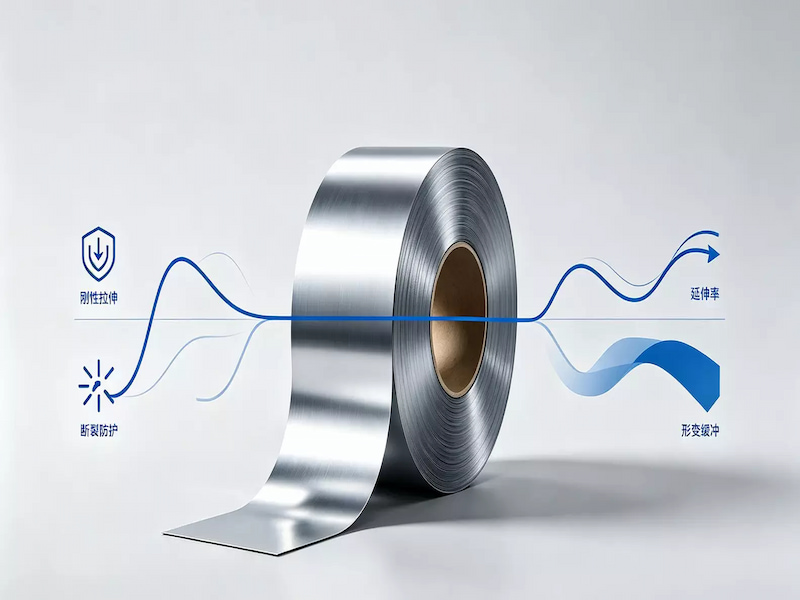
The two key mechanical properties of battery aluminum foil—tensile strength and elongation rate—directly determine production line yield rates and the long-term safety of battery cells. These two properties exhibit an inherent trade-off: higher tensile strength confers greater material rigidity and superior resistance to tensile deformation, but simultaneously reduces ductility and increases brittleness; conversely, higher elongation provides better flexibility and greater tolerance to deformation, but results in lower tensile load-bearing capacity, making the material more prone to plastic deformation.
I. Understanding These Two Key Parameters: What Process Challenges Do They Address
To achieve a scientifically balanced selection of these two parameters, it is essential first to clarify their core values during lithium battery production and cell operation, accurately identify the appropriate application scenarios, and avoid parameter mismatch.
Tensile Strength: Ensures Mass Production Stability and Prevents Belt Breakage and Deformation. Tensile strength—the ability of the aluminum foil to withstand external tensile forces without fracturing or undergoing permanent deformation—is measured in MPa. It serves as a critical safeguard in high-speed mass production and high-pressure roller pressing processes. During operations such as coating and material transport, roller pressing, slitting and traction, and high-speed winding in lithium battery production lines, the aluminum foil continuously subjects itself to constant tensile forces and instantaneous impact loads. Sufficient tensile strength can effectively prevent the foil from elongating, locally thinning, or developing unilateral relaxation, thereby eliminating batch defects—including belt breakage, uneven electrode thickness, material misalignment, and coating wrinkling—in high-speed production environments, ensuring continuous and stable line operation.
Elongation Rate: Enhances Tolerance Capacity and Mitigates Brittle Fracture Risks. Elongation rate represents the maximum allowable deformation ratio a foil can withstand before fracturing. This metric directly reflects the material's toughness and flexibility, making it a critical indicator for ensuring performance under complex operating conditions and guaranteeing cell cycle safety. In scenarios involving electrode roll pressing and bending, cell lamination/winding forming, thermal expansion and contraction during battery charging and discharging, and slight tension fluctuations in equipment, aluminum foil requires a certain amount of deformation buffer space. If the elongation is too low, the aluminum foil becomes excessively brittle; even minor deformations may then lead to micro-cracks, delamination, or edge chipping. This not only results in production scrap but also poses safety risks—such as current collector failure, surge in internal resistance, and localized short circuits—during prolonged cell cycling.
II. The Core Contradiction: Why Can Tensile Strength and Elongation not Both Be Maximized Simultaneously
The mechanical properties of battery aluminum foil are determined by alloy composition, rolling process, and temper state; the trade-off between these factors stems from the combined effects of material characteristics and manufacturing processes. This trade-off cannot be eliminated; instead, it can only be precisely balanced. High-hardness, high-tensile-aluminum foil in the "hard" state—after thorough cold rolling—exhibits a dense and orderly grain structure, stable internal stresses, and exceptional resistance to both tensile loading and deformation. However, the available space for grain deformation is constrained, leading to significantly reduced ductility and generally lower elongation rates. Conversely, soft-or semi-hard-state aluminum foil with high elongation—after temper softening—possesses ample deformation buffer space within its grains, granting superior toughness. However, its structural rigidity is insufficient, resulting in weaker tensile load-bearing capacity and a higher susceptibility to plastic deformation under external loads. In short: the hard state is strong but brittle; the soft state is ductile but flexible. No single type of battery aluminum foil can simultaneously achieve ultra-high strength and ultra-high elongation. Therefore, the primary objective in selecting material for mass production is to identify the optimal balance point that best satisfies specific process requirements.
III. Scientifically Balanced Sizing Strategies by Application Scenario
Key Considerations for Power Battery Aluminum Foil Selection: Prioritize tensile strength while also considering elongation properties. Power battery production lines are characterized by high production speeds, significant roller pressing pressures, and high winding tensions, which impose stringent requirements on the structural stability of the aluminum foil. The potential losses from production downtime—caused by foil breakage or deformation—far outweigh those associated with minor brittle failure risks. Recommended Parameter Range: tensile strength of 170–215 MPa, and elongation rate ≥ 4.0%. Aluminum foil with H18 hardness within this range offers high strength, making it ideally suited for high-speed coating and high-pressure roller pressing processes, thereby eliminating issues such as material drift, deformation, foil breakage, and wrinkling. An elongation rate exceeding 4% provides ample margin for tolerance, helping prevent micro-cracks or foil fractures induced by conventional bending or tension fluctuations. This approach balances mass production efficiency with cell quality, establishing it as the industry-standard "golden parameter" for mainstream power batteries.
Key Considerations for Energy Storage Battery Aluminum Foil Selection: Emphasize balanced matching with toughness as the primary objective. Energy storage batteries typically operate at moderate production speeds and involve milder process tensions; therefore, long-term cycle stability of the cells is the primary focus. The aluminum foil must exhibit excellent fatigue resistance and resistance to thermal expansion/contraction to prevent current collector cracking or detachment during prolonged cycling. Recommended Parameter Range: tensile strength of 120–160 MPa, and elongation rate of 5%–8%. This moderate tensile strength range adequately meets the requirements of conventional mass production conditions without inducing plastic deformation. A higher elongation rate enhances material toughness, enabling the foil to effectively accommodate volumetric changes during cell charging and discharging over extended periods. This significantly extends the battery's cycle life, fulfilling the critical requirement for long service life in energy storage applications.
Core Considerations for Selecting 3C Consumer Batteries: Prioritize scalability and compatibility. 3C batteries often exhibit large bending angles and significant deformation during molding, which can easily lead to electrode sheet cracking. Such applications demand exceptionally high flexibility in aluminum foil, while allowing for moderate relaxation of strength requirements. Recommended Parameter Ranges: tensile strength of 80–110 MPa, and elongation of 15%–26%. High-elongation soft-state aluminum foil offers superior deep-drawing properties, ensuring no cracks or edge chipping during bending and molding processes—making it ideally suited for complex molding workflows of pouch and irregularly shaped cells. The corresponding tensile strength also fulfills production requirements for low-speed and medium-tension operations, effectively eliminating defects caused by excessive deformation.
IV. The Core Logic of Optimal Balance
The key to balancing tensile strength and elongation rate in battery aluminum foil lies not in maximizing individual parameters, but in maximizing scenario adaptability. Leading manufacturers of battery aluminum foil precisely calibrate the optimal balance of mechanical properties based on customer-specific factors—production line speed, rolling process specifications, battery category, and cycle life requirements—thereby aligning material selection with process needs and minimizing defect rates.
Read More