BioPin's Carbon Coating Slurry System for Battery Aluminum Foil
Nov 23, 2026
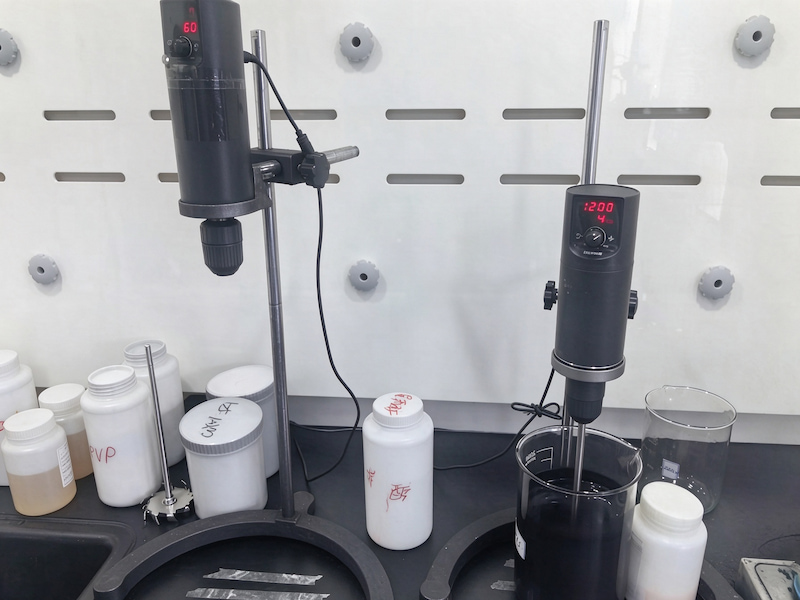
The performance of carbon-coated aluminum foil is ultimately decided by its conductive coating slurry. Instead of relying on third-party slurry suppliers, we built and optimized our proprietary slurry system internally to control dispersion, surface wettability, carbon adhesion and long-term cycling stability. This post explains the core features of our in-house slurry and what benefits it brings to your electrode or cells manufacturing.
Items
BS06
BS08
BS09
Appliaction
EV, ESS, 3C (Li-ion cell/Na-ion cell)
EV, ESS, 3C (Li-ion cell/Na-ion cell)
EV, ESS, 3C (Li-ion cell/Na-ion cell)
Apperance
gray or ash black
ash black or black
ash black or black
Coating Method
Gravure coating
Gravure coating
Gravure coating
Coating Density (g/m2)
0.6-1.3
0.5-1.5
0.5-2.0
Adhesion
No Peeling
No Peeling
No Peeling
Resistance (Ω/sq)
<5
<5
<5
Peel Strength (N/m)
>30
>20
>100
NMP-Resistant
>200 cycles
>200 cycles
>200 cycles
Electrolyte-Resistant
>200 cycles
>200 cycles
>200 cycles
Surface Tension (dyn/cm)
>56
>56
>56
RoHS
Compliant
Compliant
Compliant
Features
High peel strength,
Uniform coating,
Good adhesion.
low resistance,
Ultra-thin coatable,
Cost-effective.
High peel strength,
Uniform coating,
Good adhesion.
Our carbon-coating slurry does not follow a single, fixed formulation: the binder system, the ratio of carbon fillers, the solid-content level, and the wettability characteristics can all be adjusted to suit high-rate LFP, LMFP, sodium-ion, and semi-solid-state cathode processes. If you require TDS reports, residual-content test reports, or samples for slurry formulation matching or roll-compaction validation, please send us a request for quotation with the specifications.
Read More