Understand Battery Foils Key Aluminum & Copper Current Collector Materials
Aug 05, 2026
In an era marked by the rapid proliferation of new energy vehicles, photovoltaic energy storage systems, and digital lithium-ion batteries, battery foil serves as a fundamental material that determines the core performance of batteries, accounts for a significant portion of their total weight, and is indispensable.
I. What is battery foil?
Battery foil, formally known as power battery current collection foil, is an ultra-thin, high-purity metallic foil material that undergoes specialized rolling, polishing, and surface treatment; it is primarily used as a current collector for lithium-ion batteries, serving as both the carrier substrate for electrode active materials and the pathway for electrical current conduction.If we compare a lithium-ion battery to a miniature power plant, the battery foil serves as its main transmission backbone: during operation, the electrons generated by the active materials at the positive and negative electrodes are all rapidly aggregated and transmitted through the battery foil, ultimately enabling the input and output of electrical energy and perfectly resolving the issues of current dispersion and transmission losses. Unlike conventional packaging aluminum foil or industrial copper foil, battery foil imposes extremely stringent requirements on purity, thickness uniformity, surface flatness, conductivity, and electrochemical stability; it is a quintessential high-precision, high-barrier new energy material.
II. The Two Major Core Categories: Aluminum Foil vs Copper Foil.
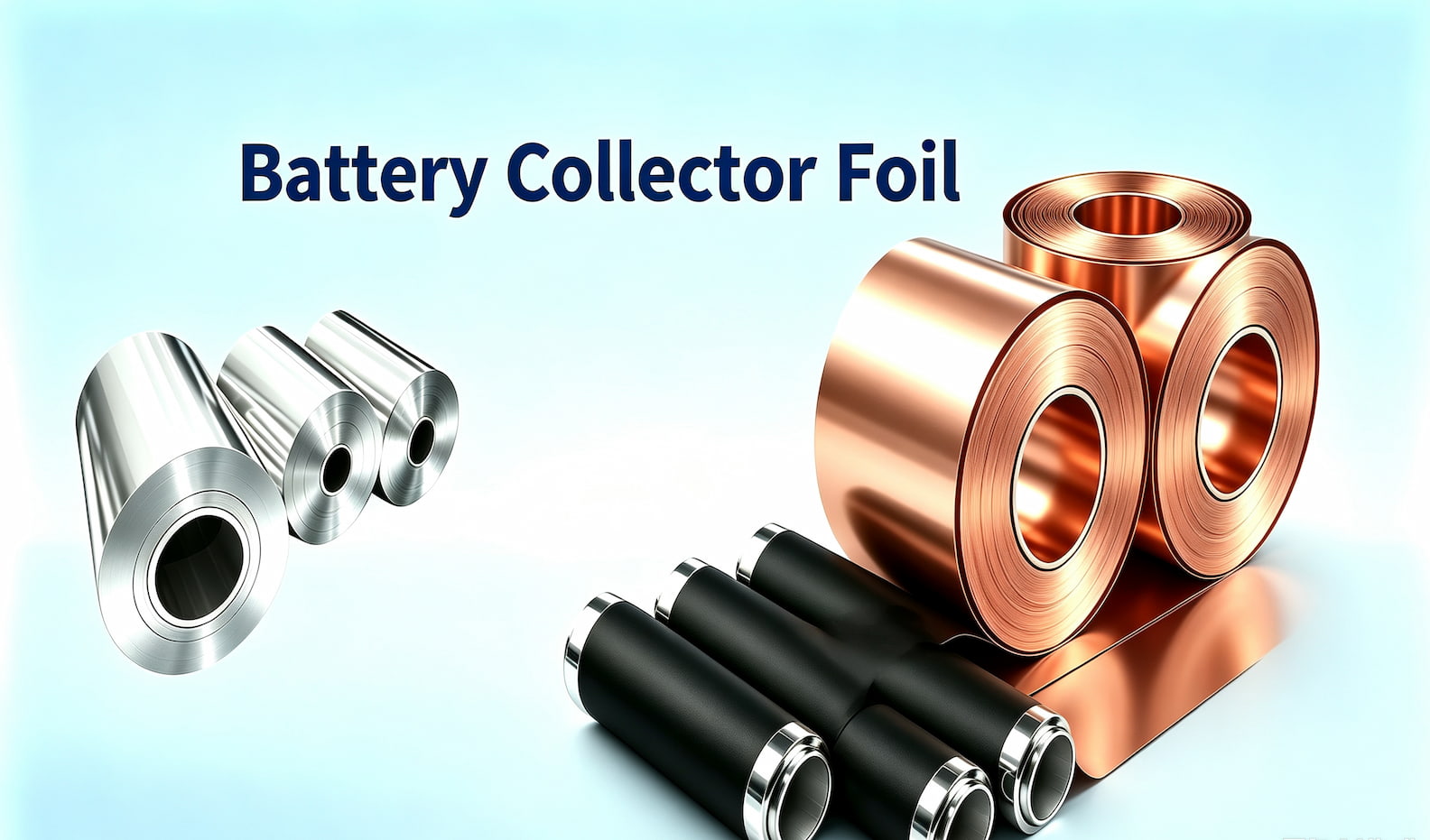
The operating environments and electrochemical properties of the positive and negative electrodes in lithium-ion batteries differ significantly; therefore, battery foils are divided into two main categories: battery aluminum foil and battery copper foil. These two types have clearly defined roles and cannot be interchanged, as they are specifically designed for different electrode applications in batteries.
Battery aluminum foil
The cathode-specific current collector aluminum foil serves as the core substrate for lithium-ion battery cathodes; it is typically fabricated from high-purity aluminum with thicknesses ranging from 10–20 μm; for high-end power batteries, ultra-thin specifications of 6–8 μm are employed. Thanks to its advantages of light weight, strong oxidation resistance, and controllable cost, it perfectly adapts to the high-potential oxidative environment of the cathode.Conventional aluminum foil can only meet basic electrical conductivity requirements, whereas carbon-coated aluminum foil has become the mainstream upgrade solution; by applying a conductive carbon layer to its surface, it significantly reduces interfacial contact resistance and enhances the adhesion of the active material, thereby markedly improving the fast-charging performance and cycling stability of batteries, and is widely used in high-energy-density power batteries and energy storage batteries.
Battery copper foil
The cathode core carrier battery copper foil is used as the cathode current collector in lithium-ion batteries; leveraging copper's exceptional electrical conductivity (which far exceeds that of aluminum), it can minimize electronic transport losses to the greatest extent, adapt well to the reducing operating environment of the cathode, and resist electrochemical corrosion. Currently, mainstream power batteries utilize 4.5–8 μm ultra-thin copper foils; this extreme thinning design allows for greater space within the battery, enabling the incorporation of more active materials.The traditional electrolytic copper foil process is well-established and cost-effective, making it the mainstream choice in the market; in contrast, composite copper foil (PET copper foil), as the next-generation technology, employs a "polymer-based film + double-sided copper layer" sandwich structure, offering advantages such as high strength, enhanced safety, and extended service life.
III. A thin layer of battery foil determines the four core performance characteristics of a battery.
Not determined solely by the materials used for the cathode and anode, the battery's performance upper limit is directly dictated by the quality of the battery foil.
The fast-charging capability is determined by the charging efficiency; the electrical conductivity uniformity and surface flatness of the battery foil directly influence the internal resistance of the battery. High-quality battery foils exhibit lower internal resistance and more uniform current distribution, resulting in less heat accumulation and reduced energy loss during charging—thereby forming the foundation for achieving high-current fast charging. Conversely, inferior foil materials with uneven thickness or contaminants on their surface can easily lead to localized current overloads, not only slowing down the charging process but also accelerating battery aging.
Enhancing energy density and extending driving range: Battery foil accounts for 15%–20% of the total weight of lithium-ion batteries and represents a key breakthrough in battery lightweighting. While ensuring strength and stability, the thinner the foil material, the smaller the volume it occupies within the battery, the greater the amount of active material that can be packed into the battery, and the higher the energy density achieved. Data indicate that ultra-thin foils can help power batteries achieve an increase in energy density of approximately 15%, directly enabling the enhancement of driving range in new energy vehicles.
Ensuring battery safety and eliminating thermal runaway risks: The toughness, corrosion resistance, and structural stability of battery foils serve as the core safeguards for battery safety. High-quality copper and aluminum foils exhibit excellent electrochemical corrosion resistance, resist powdering or fracture during long-term cycling; whereas composite foils effectively address the common issues associated with traditional foils—such as susceptibility to tearing and puncture—thereby effectively preventing short circuits between the positive and negative electrodes under battery extrusion, impact, or needle-puncture scenarios, and significantly reducing the risk of thermal runaway.
Extending the cycle life and reducing operating costs: During the battery's charge and discharge cycles, the current collector must endure repeated ion insertion and desorption over an extended period. High-purity, high-stability battery foils can maintain a tight adhesion to the electrode material at all times, thereby preventing contact failure and a surge in internal resistance, which significantly increases the battery's number of cycles and substantially extends the service life of both power batteries and energy storage batteries.
IV. Emerging Industry Trends: Ultra-thinization, compositing, and functionalization.
With the high-endization of new energy vehicles, the scaling-up of energy storage systems, and the lightweighting of lithium-ion batteries, the battery foil industry has long moved beyond mere "scale competition" and entered an era of technological iteration and competition; these three major development trends have become increasingly pronounced.
Pursuit of extreme ultra-thin profiles has established ultra-thin battery foils as industry standard: to meet the demands of high-energy-density batteries, battery foils have undergone continuous thinning upgrades—aluminum foils have been reduced from traditional 20 μm to 12 μm and 8 μm, while copper foils have evolved from 10 μm to 6 μm and 4.5 μm; consequently, the penetration rate of ultra-thin foil materials has steadily increased, making them the standard choice for mid-to-high-end power batteries that balance lightweight design with high performance.
The adoption of composite foil materials as substitutes for traditional foils is driving a technological transformation. Traditional pure metal foils suffer from insufficient strength, susceptibility to corrosion, and limitations in safety; in contrast, PET/PP composite copper-aluminum foils—thanks to their superior safety, high toughness, and long service life—have emerged as a core direction for the next generation of battery foils. Currently, composite foils are being progressively integrated into the supply chains of leading battery manufacturers, and it is anticipated that they will gradually replace conventional electrolytic foils in the future, thereby reshaping the industry landscape.
Surface functionalization treatment enables a comprehensive performance upgrade: conventional smooth foil materials often struggle to meet the demands of high-end batteries; consequently, functionalization techniques such as carbon coating, anti-oxidation coating, and anti-slip coating have gained rapid adoption. Functionalized battery foils can effectively reduce interfacial resistance, enhance material adhesion, and improve corrosion resistance, thereby perfectly aligning with the development requirements for fast-charging, long-cycle, and high-safety batteries.
From consumer-grade lithium-ion batteries to power batteries and large-scale energy storage stations, battery foil—as the most fundamental and core structural material in lithium-ion batteries—has consistently played a pivotal role throughout the entire development process of the new energy industry, serving as a key breakthrough point for enhancing battery performance, improving safety, and optimizing costs.
Read More